


B2C - Target customer canvas
The B2C (Business-to-Customer) target customer canvas is a tool for defining your Ideal Customer Profile (ICP). Having an ICP helps you increase your chance of success:
You can create a product that will better match their needs, leading to them buying more.
Avoid confusing product feedback from people with conflicting needs.
Be more efficient with marketing and sales efforts.
Target the most profitable customers.
Before you define an ICP, start by modelling your product’s value proposition in CPF’s Product Positioning stage. The creation of a value proposition and an ICP is an iterative process.
Competitors may not be targeting exactly the same customer groups as you. Despite this, there may still be some overlap. The diagram below shows how customers defined in your ICP can be impacted by a competitor:

B2C - Target Customer Canvas
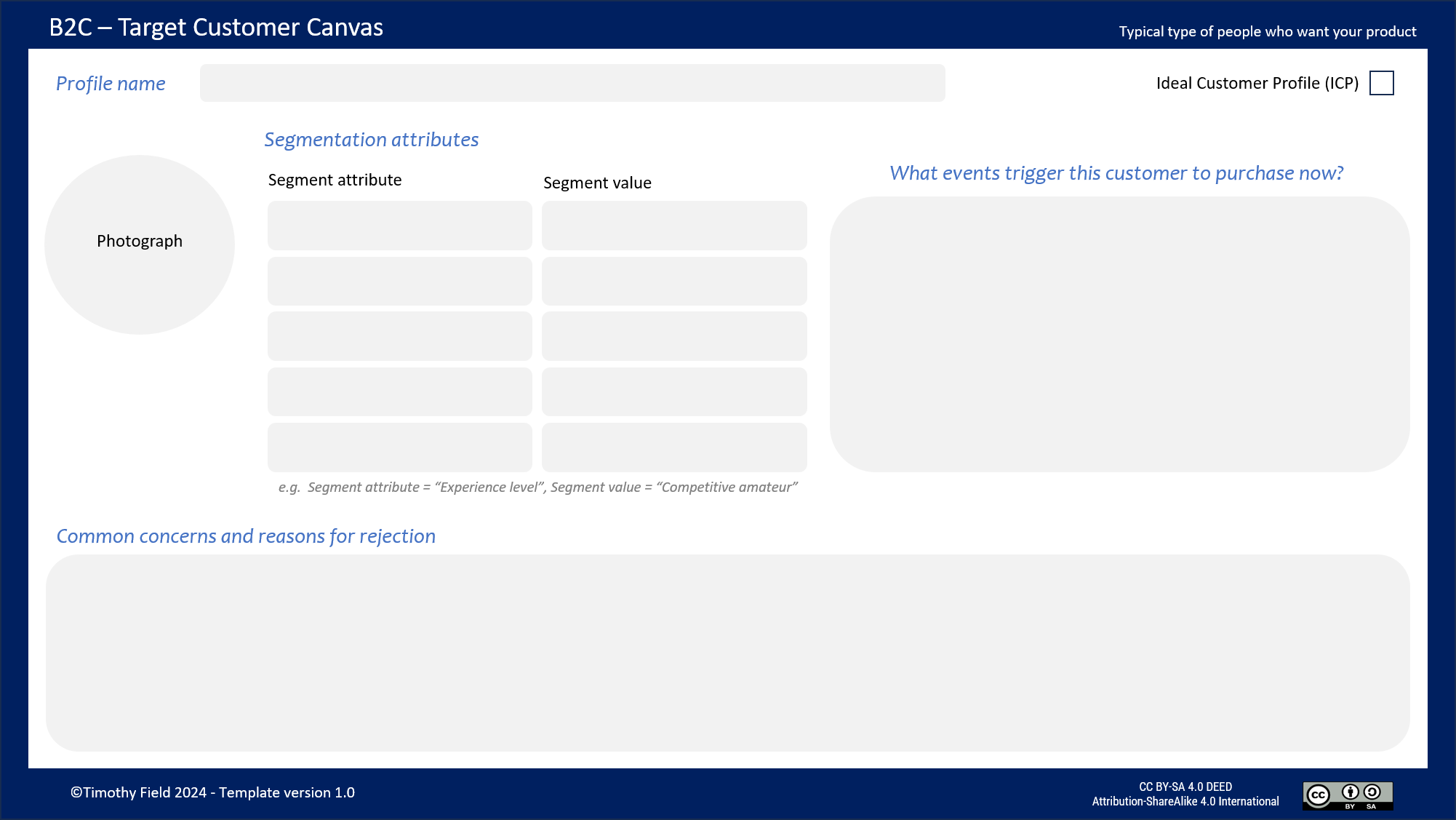
Feel free to recreate the canvas in a tool of your choice. Please attribute the author (Timothy Field), the source of the canvas (this webpage) and add the CreativeCommons BY-SA license
Your ICP can change
With an established product, your ICP may change over time. There are several reasons you may want to change, including:
Functional depth - You initially have a simple product that only appeals to lower-value customers. You decide to shift when you have built enough product functionality to serve more profitable ones.
Access - You initially only have easy access to smaller, lower-value customers. You decide to shift when you have a strong enough reputation to serve more profitable ones.
Competition - Market competition is very high, and you are struggling with profitability. You decide to pivot your product offering to a different group.
Expansion capacity - You have fully catered for your customer’s needs and have capacity to take on new types of customer.
Expansion opportunity - You spot a new opportunity for higher profit with a different type of customer.
Here is an example using the functional depth factor above applied to a training product. You start by targeting casual runners as they don’t need much functionality. Over time, your product grows, and you decide to target higher-profit competitive amateurs. These decisions should not be taken lightly, as they can impact everything from how you market to what you build. For a new product, you should just use one and focus on better understanding your ICP.
Profile anti-patterns
1) Not based on research
Making up profiles is the number one anti-pattern. This means you have made a lot of assumptions about your customers or have based them on poor-quality information. If a product team wishes to get together and create profiles, this is fine as long as they are validated later. Defining quantified problem statements is good practice as it requires research.
2) Irrelevant information
Talking about irrelevant information in profiles, such as the fact that the person has a dog and enjoys walking. This information has no value to our product development. This anti-pattern is common when people want to bring that person to life, but it isn’t helpful.
3) Not using them in product development
You should look for real people who match your profiles and then use them to test out ideas and new products. If you have a large product with many features, you may have a number of profiles. When creating new features, these may be targeted more towards specific people. In this case, make it clear in your strategy which persona the feature is aimed at.
4) Not using them in product marketing
Consider where new customers can be reached, for example, the social media channels they are on, so you can target your messaging. You may also segment your current customer base and target marketing at those.
5) Not targeting specific profiles
We need to be focused on who we are building and selling our product to. If we don’t do this, we end up with confusing feedback and too many wants and needs. Therefore, we should avoid creating too many profiles. Imagine having 10 and trying to make them all happy! Create profiles for who you are selling to.
6) Too many profiles
Avoid creating too many profiles. Imagine having ten and trying to make them all happy! Instead, create profiles for the key customer types you are selling to. If you are a new company or selling a new product, it is advisable to start with just one.
Market size
Total Area Market (TAM), Service Available Market (SAM) and Service Obtainable Market (SOM) help you define your target market. After you have created your ICP (segmentation tab), you should consider each of these and see if you need to adjust your ICP or product. You may even need to stop development.

Total Available Market (TAM)
TAM represents winning every sale in the market without restrictions. It is very useful for measuring the market’s potential for growth.
“Total Addressable Market (TAM), also referred to as total available market, is the overall revenue opportunity that is available to a product or service if 100% market share was achieved.” - Corporate Finance Institute.
Too large: For example, you are competing with the entire tyre-building industry with a new road tyre. You can do this, but it will be hard to win when the competition is very high.
Too small: You have an extremely niche product. For example, software for a very specialist type of hospital. You can do this, but expansion opportunities will be very limited or expensive. This can work if the profitability is very high. The investment may not be justified for new products if the TAM is too small.
Service Available Market (SAM)
SAM represents the proportion of TAM that you can realistically target and serve. These restrictions include:
Target restrictions such as regulations, geography and distribution.
Service restrictions such as support and logistics.
Service Obtainable Market (SOM)
SOM is the realistic amount of the SAM you can expect to win over a timeframe (e.g. a year):
For new products, this will be put in terms of stretch targets. For example, five sales in the next 6 months.
Take into account the percentage of customers that match your Ideal Customer Profile, as these are more likely to buy.
For existing products:
The likely level of sales based on previous results.
Your new messaging and features that will drive additional sales.
Your competitor’s new messaging and features that will result in them winning more business.
Ideal Customer Profile refinement
After you have created your ICP (segmentation tab), you should test and refine it. This analysis can be done with a sales team’s input. If the data is too difficult to collect in full, you could do this from a sample of your latest sales:
ICP - Classify sales that meet your current ICP definition and those that don’t.
Classify - Assign each sale to a grid quadrant.
Consider - Does your current ICP match your sales information?
Refine - Update your ICP as required.

Expanding your ICP
In the top left-hand side is an Experiment option. These high-value customers are hard to win. You should identify why this is. For example, they need a lot of high-cost manual product demonstrations. Create experiments to speed this up. For example, automating the product demonstration process.
Segmentation and Ideal Customer Profile (ICP)
I’ll start with product-market fit, for which there is no commonly agreed definition. Here are the views of some industry experts:
Andy Rachleff: "To me, product-market fit is when you have proven the value hypothesis. So the value hypothesis is the what, the who and the how."
Marty Cagan: "the smallest possible product that customers will buy, can use, you can build, and your stakeholders will support."
Marc Andreessen: "Product/market fit means being in a good market with a product that can satisfy that market."
Sean Ellis: "I define product/market fit as at least 40% of your active users saying they would be 'very disappointed' if they could no longer use your product."
Dan Olsen: "Why do products fail? One of the main reasons why is because they don't meet customer needs in a way that is better than other alternatives. That is the essence of product-market fit."
Segmentation attributes
Your target market starts with a group of people with the same needs or problems. Consider cyclists who keep getting punctures as an example. I have created a product to repair these punctures. Let’s look at the options to properly define these people, i.e. the market:
Demographic segmentation - e.g. age, gender, income
Geographic segmentation - e.g. where you are from
Behavioural segmentation - e.g. time of year, usage, customer loyalty, benefits sought
Psychographic segmentation - e.g. social class, values, personality, activities and interests
It is a common anti-pattern to only consider demographic and geographic segmentation. Consider a puncture repair product and imagine my cyclists are segmented like this:
The female countryside cyclist
Age: 18-40 years old
Location: countryside
Gender: female
The male city cyclist
Age: Over 40 years old
Location: city
Gender: male
I hope you can see that this way of segmenting isn’t helpful. The segmentation categories of Age, Location and Gender will not affect the type or frequency of punctures in any meaningful way. In other words, the product will not change based on these. The next section will help you define an optimised target customer group. After this, we will redefine the puncture repair example.
Ideal Customer Profile (ICP)
An ICP is the customer group you should target to maximise success/profit as shown in the grid below. They are used in marketing, sales and product development. The profitability represents the entire group, for example:
10 large customers at 100K profit = 1M total profit
500 small customers at 1K profit = 500K total profit
An example of a poor ICP would be a large customer with a very long sales cycle who demands a very low price. Although these customers may feel important, your profitability will suffer.

This shows that although you can go after every customer who could buy, it can be a costly waste of time. You should take the following considerations into account when segmenting:
Customer needs
Market maturity stage
Disruptive innovation
Price - Sensitivity and affordability
Our restrictions - The limiting factors as to who we can reach
Market size
We will now look at these factors in detail.
Customer needs
We need to start with segments that differentiate customers based on the specific problems they need solving. This is the most important point to consider. This is not as simple as it seems. For example, let’s consider how I would segment an organisation selling a graphics program. One company uses it to improve their event pictures, and another for creating marketing flyers. Although these sound very different, the toolset required is very similar. This is not a good way to differentiate. You can still run marketing campaigns to target these different groups, but the core product is the same. When segmenting, consider what sort of use cases your product supports and whose needs it best meets.
Maximise profit by meeting needs
By meeting the needs of the target Ideal Customer Profile (ICP), they will be willing to pay more. Note that this ignores affordability for now.

When determining if needs are currently being met, consider:
The percentage of customers with very poor solutions, such as manual workarounds. For example, when checking data quality, are they doing this manually?
The percentage of customers who have created their own solution. For example, have they built a reports engine in Excel?
The percentage of customers who use a direct competitor:
What do they like about this solution?
What problems are there with this solution?
How easy will it be for them to switch?
Market maturity stage
When a new superior type of solution is released, it typically creates a new market. There will be many new customers available willing to pay a premium due to the novelty and lack of competition. As more competitors join, the market matures and profitability reduces.
Mature markets
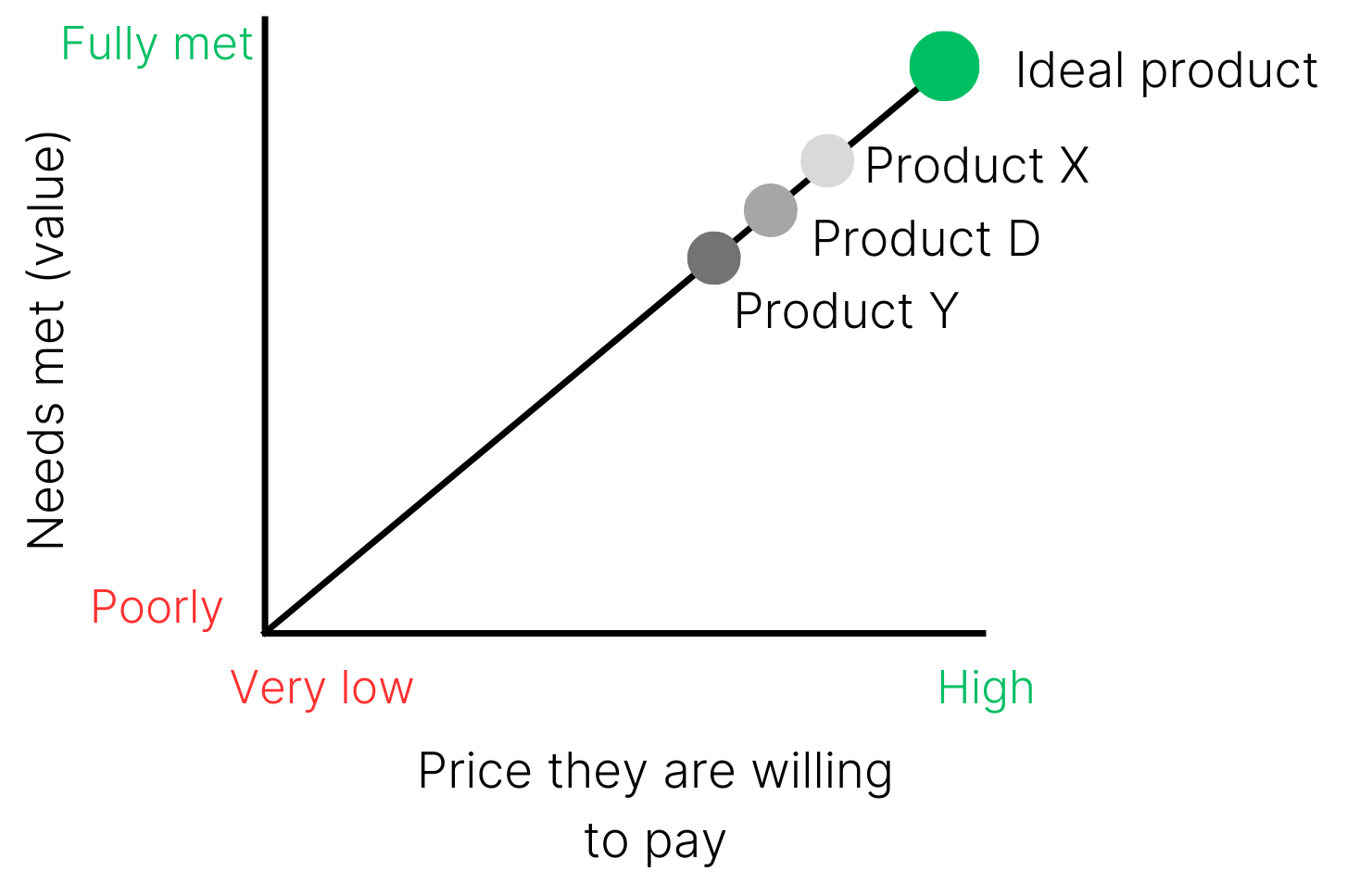
Entering mature markets can represent a big challenge. Products can be large and mature, leading to high entry costs. Additionally, established brands can have customer loyalty based on trust. Here you can see three very similar products that are optimised. It will be very hard to enter this market:
Targeting niche customers
One strategy to avoid high levels of competition is to target niche customers. By focusing on needs that are poorly served in the market, you can create a differentiated product that is more likely to sell. Take, for example, the very mature digital camera market. It will be very difficult to establish a new compact camera. Here is where niche needs can help:
Example 1 - You could create a compact camera aimed at weddings where guests can capture memories of the event for the happy couple. With this very specific use case, you identify key weaknesses with current solutions and gain an advantage. In the case of current cameras, they have a basic design, are damaged by water, fragile and too expensive to leave with guests. This opens up the opportunity to create a new product. The product differentiates by being water and drop proof, with beautiful designs and a low price.
Example 2 - You could make a camera targeted at cave divers. With this very specific use case, you identify key weaknesses with current solutions and gain an advantage. In the case of current underwater cameras, you identify that they are bulky and prone to breaking when hitting rocks. This opens up the opportunity to create a new product. You should begin with user research to understand the issues with current solutions.
In the picture below, you can see that current solutions are not meeting these niche needs:

When determining if needs are currently being met, consider:
The percentage of customers with very poor solutions, such as manual workarounds. For example, when checking data quality are they doing this manually?
The percentage of customers who have created their own solution. For example, have they built a reports engine in Excel?
The percentage of customers who use a direct competitor:
What do they like about this solution?
What problems are there with this solution?
How easy will it be for them to switch?
Disruptive innovation
If you can disrupt an entire industry with a new innovation, you may target a broader customer group. Your marketing spend is likely to be lower as word of mouth and free press coverage promote your product. New types of product should solve a major problem with existing solutions. They can reset expectations of the ideal product. Consider the invention of the mobile phone. At the start, if your product is not mature, people may still select the old type of product. Mobile phones were very big and difficult to carry at the start. As they improved, they overtook, then replaced, old solutions, in this case, phone boxes.

Segmentation based on price
An important consideration when segmenting is the impact of price:
Price sensitivity
Some customers who see low value in a product will select basic products that are differentiated by low price. Any additional functionality is a benefit to them. They will still believe that the low-cost option is good enough to fulfil their basic need, rather than being of poor quality. They may still filter low-quality, low-price items out. For example, seeing many reviews that the product doesn’t work.
The opposite can be true, where a customer will pay a premium for a high-quality service. They are not very price-sensitive and simply want the best. This premium end of the market can be very profitable for the best products.
Affordability - Regardless of the value of your product to a customer, affordability can stop them from purchasing. By setting a high price, you limit their access. Where you have sufficient demand, consider:
Consider the size of the market if your product is expensive.
Consider starting with a low-cost product that you can expand. This is particularly relevant to software, where you can add additional features.
Our restrictions
Market entry restrictions can present challenges. When creating your ICP also consider:
Reach - Only being able to reach a section of the market.
Marketing capacity/budget.
Geographic location.
Service capacity - This will lead to tighter segmentation. For example, if support costs are very high, you may only go after high-value customers.
How many customers you can sell to.
How many customers you can support.
Regulations - Legal or regulatory requirements that can limit you.
Other - You may have other restrictions. It is critical to identify these when creating a new product.
Market size
You are now ready to evaluate your market size (market size tab). You may need to adjust your ICP if the market is too small.
ICP process
Step 1
With a product defined, you can now create your ICP using the canvas.
Step 2
Can we maximise success/profit with this ICP?
Customer needs - Does our product strongly match the ICP’s needs, and is it better than how they are solving this now?
Market maturity stage - Do we understand how crowded the market is, and can we compete?
Disruptive innovation - If we have this, can we target a broader customer group?
Price sensitivity and affordability - Is our product affordable to them, and will they buy this?
Our restrictions - Are we limited by any restrictions? Who we can reach, our support capacity, and regulatory requirements?
Market size - Is the market large enough?
Step 3
Refine the ICP when results come in (ICP refinement tab).
ICP Process Example
Going back to our puncture repair product for cyclists, we can now create a better ICP.
Our product - This is a very fast, light and extremely reliable puncture repair patch that dries within 1 minute. This premium product is a luxury item and has a high price.
ICP - The cyclist who races
Race frequency: Over 3 times per year
Benefits sought: As close to 100% puncture repair success rate as possible
Price sensitivity: Very low
Affordability: Very high budget
Using the ICP checklist:
Customer needs - When racing, the failure rate of puncture repair kits is extremely important.
Market maturity stage - Alternative premium solutions are good, but we have a better puncture repair success rate, so we’re happy we can differentiate.
Disruptive innovation - Our product is not disruptive (it is similar to other premium solutions).
Price sensitivity and affordability - These racers are not price-sensitive due to the cost and effort involved in racing.
Our restrictions - We can sell globally, but will focus on the UK for now due to support restrictions.
Market size - The market is small but highly profitable. With success, we can expand into further premium customer groups.