


Introducing the Commercial Product Framework

Why use CPF?
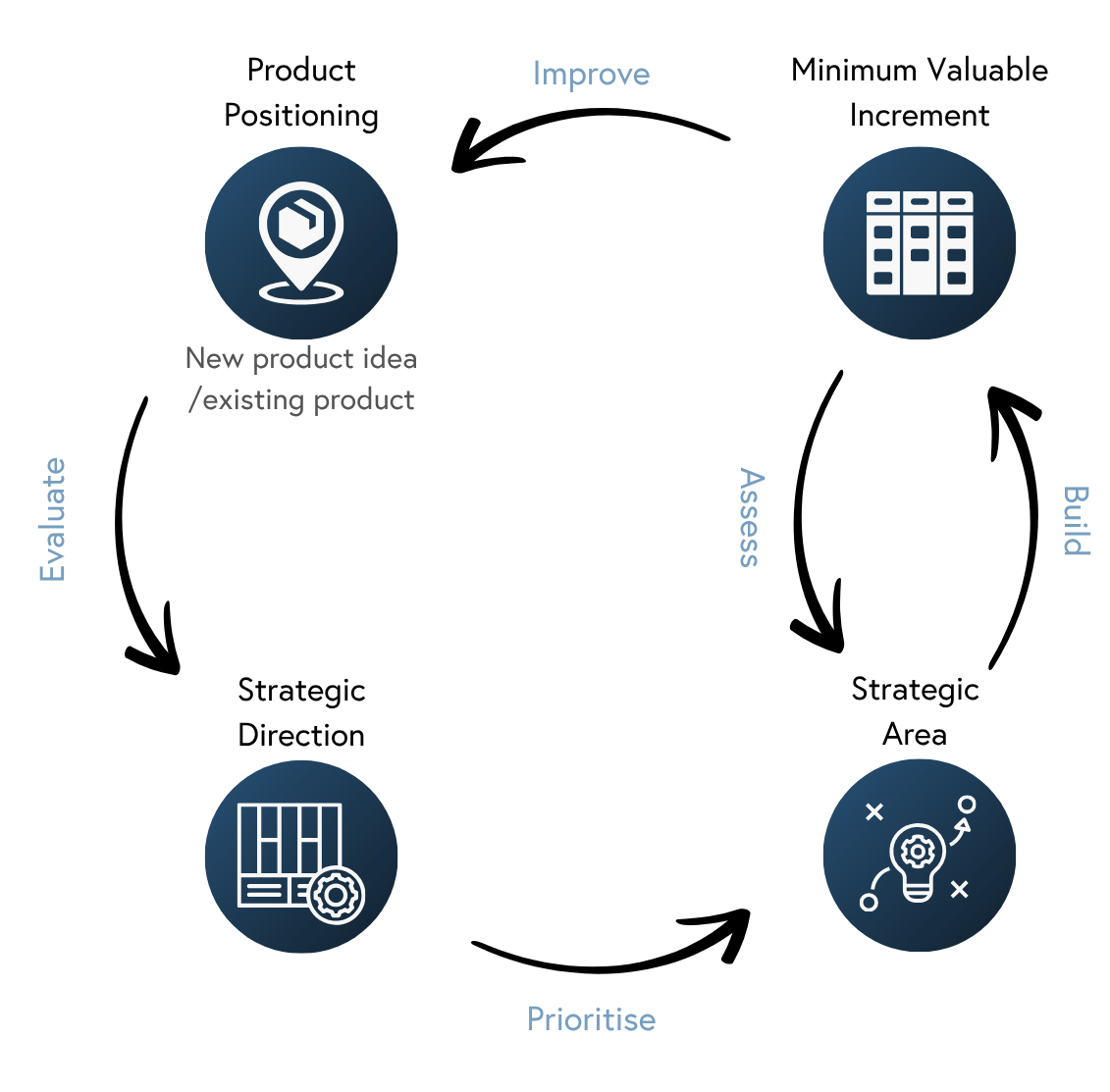
Here you can see the high-level flow of CPF, which starts with a new or existing product. Many delivery frameworks just bolt on some lightweight product practices that won’t enable you to develop a successful strategy. CPF answers the following big questions:
How do I ensure my product’s value proposition is clear and optimised?
How do I balance addressing issues against growth and market expansion in my product strategy?
I know about activities like churn analysis and creating buyer personas, but how do I actually structure them?
How do I avoid building things customers “like” but won't pay for?
You can use CPF end-to-end, or select from its set of modular standalone tools.
It is primarily designed for digital products and services. For example, a SaaS offering or insurance that is bought and managed online. It can be used for physical product creation, but it will need some adaptation. CPF is not AI-generated, it is the result of hands-on implementation experience.
Benefits in detail
This section will demonstrate some of the advantages of CPF, including why it is called a “commercial” framework.
Creating a new product - business modelling and commercial viability
What can possibly be wrong with a solution-first approach with small changes following user feedback? This is the classic “Test and Learn” approach that many Agile teams follow:

The customer research trap
Let’s use an example to show why commercial viability is important. You decide to offer an improved service level of 24/7, covering weekends. You write up a problem statement showing the number of major issues on weekends. Next, you ask if your customers want this service and find that most are delighted. You spend the next two months recruiting and additionally offering evenings and weekend overtime. You are ready to go! With your new service, you approach your customers for an extra £100 a month. At this point, you discover no one is interested in paying.
Commercial viability is not the same as asking if someone “likes” something. You need to understand if they will pay for it.
The impact of adding low-value features
In digital products and services, you may be creating new chargeable features. When unsuccessful, this may result in the feature being added to the core offering and given away for free. Lost revenue is not the only issue:
Value proposition - As your sales team starts pushing these low-value features, the core value proposition weakens and becomes less attractive.
Confusing product - This can result in your product being bloated with features that aren’t particularly useful. This creates user dissatisfaction where a product has features continually added to it that aren’t very good. It can make your product harder to understand.
Maintenance costs - You have to support and maintain these features. For example, you may have just a couple of customers using a feature, which costs you more to support than you make back in revenue.
CPF approach
Next, we will compare how CPF works for creating new products and paid features.

Creating a business model
CPF uses a structured process with canvases that starts with the business model. This helps you test your ideas against product-market fit. Even from basic analysis, you may discover major issues. For example, the problem you are solving for customers doesn’t look big enough, or your competitors have very large products that you cannot compete with.
Testing assumptions
CPF then asks the following questions and helps you identify your major assumptions:
Feasibility - Can it be built and run for a sensible cost?
Desirability - Do customers want this?
Viability - Does the business case stack up? Consider if this will justify the return on investment.
Important assumptions can be defined as those that, if wrong, will cause your idea to fail. For example, you may have an old system and need to check if your design is performant. Testing key assumptions early can save a large investment. You also have the option to pivot the idea rather than stop the work.
Validate with a Minimum Viable Product
You are now ready to start the classic “Build-Measure-Learn” approach. The MVP is a basic version of the product/feature containing just enough functionality to solve the customer’s problem(s). This is used to validate the idea in the market with minimal investment, where there is significant uncertainty about market fit.
Strategy versus iterative change
In this section, we will consider incremental improvements to a product or service.
Problems with strategic planning
Traditionally, organisations have focused on business strategy with longer-term planning. Each business case contained a lot of detail, including financial modelling. This investment and the “certainty” provided by analysis made it hard to back out. Large work items took months or even years to deliver. For a low-risk change in a stable market, this could work. However, where conditions were more uncertain, this could lead to a very expensive failure.

Emerging competition
Even in traditionally stable markets, new competition can emerge and start to eat market share. Organisations with long-term planning cycles will not be set up to respond quickly and can be overtaken. The need to rapidly innovate requires a major shift in operations and culture. There are many examples of very successful organisations that don’t exist now.
Problems with iterative change delivery
Moving to Agile-based methods, we can see a move away from structured business cases to rapid deployment of small changes. This adaptive culture allows for much faster releases of value.
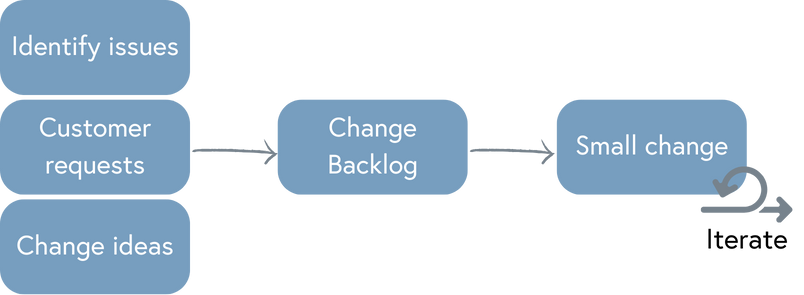
The business case that includes, “How will this make us money?” mentality is replaced with a backlog full of small changes. The product owner is typically juggling requests from large customers, alongside changes to increase customer satisfaction. These organisations are now able to adapt quickly. However, the lack of strategy and commercial focus has meant many features and changes being built, although good, don’t lead to increased revenue. These organisations will be burning through money despite high customer satisfaction rates.
The impact of competition
When the competition has more structure to their strategy, they can get ahead. For example, they focus on creating stronger differentiation or are tackling reasons for sales loss. Eventually, this can collapse an organisation as each competitor gets stronger and stronger.
CPF approach
Next, we will compare how the CPF strategy layer works, helping you avoid these anti-patterns:

CPF begins with Strategic Inputs, which include metrics and competitor analysis. These allow you to prioritise a Strategic Direction. These include options like reducing sales loss and churn, reducing costs and creating new products. This is different to every other framework. With this priority, you can now look for options. CPF provides structured inputs for this, including PESTEL trend analysis and Customer Journey Maps. After you have prioritised your options, you create Strategic Areas. This allows you to structure your strategy. Finally, to avoid long lead times, a Minimum Valuable Increment is built. The results of which go back to the Strategic Area.
Overall, this helps you think strategically and deliver rapid change.
Get in touch…
If you’d like help using CPF, please reach out today for a conversation