


Strategy Item guidance
Guidance overview
Strategy Items are lightweight artefacts used in the Commercial Product Framework’s Strategic Direction stage. They allow you to gather options that can be prioritised.
This guidance covers:
Strategic direction - A quick overview of the potential directions.
Strategy Item overview - Capture the options you have to implement your strategy.
Granularity of Strategy Items - Making sure your items aren’t too big or small.
Pre-filtering Strategy Items - Making sure your items are achievable.
Strategic direction
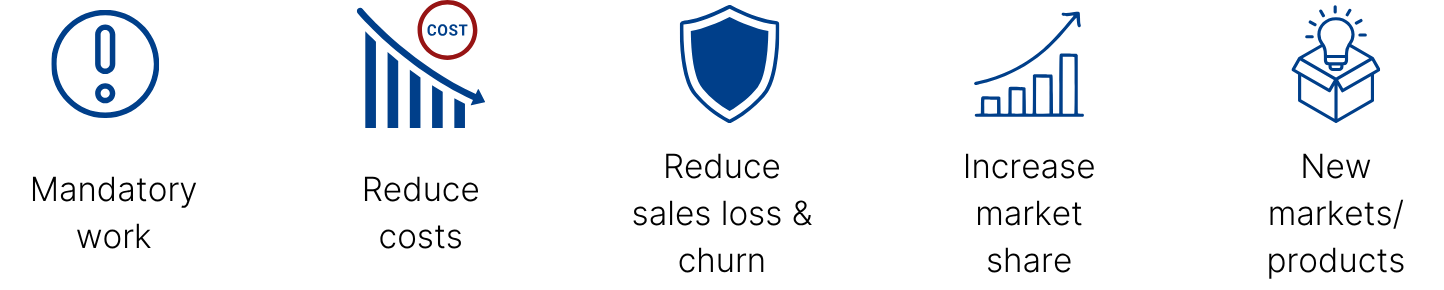
The Strategic Direction stage of the framework helps you prioritise one or more of these areas. Mandatory work is excluded from prioritisation as this must be done regardless.
Strategy Item Overview
After we have our direction, we can shape options at a high level, ready for prioritisation. These are intentionally lightweight but can be augmented with additional artefacts. For example, a screen design. Their attributes are built out when a strategy is selected. They are shown as a digital “post-it note” but can take any lightweight form. Lightweight should not mean poor quality. In the example below, you may have completed a high-level design for the support process. Without this, a strategy may get selected that is destined to fail.

Problem to solve - Perhaps the most important factor of all. You could be solving a problem for a customer or your organisation. Where possible, quantify this to determine impact.
Solution summary - A very simple overview of how to solve this. It is not a list of technical options.
Investment period - How much time you expect to invest to achieve your expected benefits. 3 or 6 months is a typical starting point. This is not an estimate of work item size. At this stage, doing detailed design work to create an accurate estimate can create major waste if work isn’t taken forward. It will also force early design decisions that may be poorly thought through.
KPI this impacts (optional) - KPI stands for Key Performance Indicator. You may be reducing the churn rate or the Customer Acquisition Cost (CAC rate). This helps you directly link to a metric and can be used where it is not obvious.
Work purpose - This maps to one of the five listed strategic directions in the section above. In the example, we can see a Strategy Item linked to Reduce sales loss & churn.
When they are Strategic Items are selected, they will be built out using:
Strategic Area - For incremental improvements to an existing product.
Product Positioning - For new products, including new chargeable features. This helps you shape the value proposition and reduce commercial risk.
Granularity of Strategy Items
When creating strategic items, consider:
Investment period - How much time you expect to invest to achieve your expected benefits.
Impact - Impact represents the size of the problem you are solving.
We have a strategy to make a large, measurable impact on the organisation. Making many small changes and assessing their individual impact makes this difficult to see. Also, with too many small items, we don’t get enough feedback on whether the overall strategy is working. Here we have a low Net Promoter Score (NPS) from customers due to significant issues with product usability. The example is deliberately simplified to demonstrate the granularity (i.e. the problem is not quantified, etc.).
Example 1 - Too granular
Solution summary - Redesign the signup screen that is poorly implemented. Fields don’t adhere to visual standards, and error-handling messages are currently unclear.
Investment period = 1 week.
The impact here on the NPS score will be low. The change simply isn’t big enough to move the needle. This doesn’t mean you can’t just get on with fixes like these, but it is far too low-level to prioritise as a strategy.
Example 2 - Too broad
Solution summary - Tackle UX inconsistency across my whole product.
Investment period = 1 to 2 years.
The impact here on the NPS score will be high, but the Return on Investment (ROI) of spending more than a year on this may mean it is not worth it. There is a risk that the team may end up bringing in low-impact work as the investment period is barely bound.
Example 3 - About right
Solution summary - Improve the UX inconsistency within the data transfer process.
Investment period = 3 months of investment is expected.
With our third example, we have identified an area that will have a high impact on the NPS score and has a justifiable time period. The added benefit of a time-bound strategy is that it allows you to consider whether the ROI is worth it. You can still stop before the 3-month period ends if customer feedback is poor or the solution looks like it’ll take much longer.
Pre-filtering Strategy Items
The aim is not to generate hundreds of options but a select few that are high quality.
Pre-filter based on risk
As you work through your Strategy Items, you may decide that they carry too much risk to prioritise. When deciding on whether or not to consider a Strategic Item for prioritisation, consider the following questions:
Desirability considerations - Evidence that customers want this:
Do we have evidence that this solves a big enough problem for customers? (Ideally, quantified).
Is the type of solution or level of differentiation very new in the market?
Do we have evidence that customers want the solution and will switch from current solutions?
Feasibility considerations - Evidence that we can build and run this:
Do we understand the technical design, including the ability to build it and ensure it will scale to customer demand?
Do we understand the service design, including the ability to run it and ensure it will scale to customer demand?
Do we have any major risks that could lead to this failing or greatly increasing in cost?
Viability considerations - Evidence that this will generate a profit:
Do we know which pricing model we will use, and that its target price point is competitive?
Do we have evidence that customers will pay?
Do we understand the costs, including build, customer acquisition and running the service?
Do we know the break-even point for investment and how long to achieve a good Return on Investment (ROI)?
Research is important
You may need to do further research to understand these factors above. Take into account that you may be asking for hundreds of thousands of pounds/dollars/euros of investment. Due diligence should be done with this in mind.
You shouldn’t filter out high-risk items with potentially great rewards. We don’t want to remove all our innovation opportunities. For example, you may not be certain that customers will pay for your new product idea, but you want to raise it as a discussion point. In the Strategic Direction stage Strategy Items will be judged on “Evidence this will work” and you should raise any risks there.
Pre-filter based on investment period
You may have a great idea for a new product, but if you know it would take years to develop (as an extreme example), you may decide not to raise it.
Pre-filter based on team capacity
You may limit the number of Strategy Items you are creating based on your capacity:
Aiming for each team to have one strategy to work on.
The number of teams you have. For example, having 3 teams and evaluating 30 potential strategies will be a waste of time and effort.
Amount of investment period left on their current strategies.
Likelihood of their current strategy being continued (see below).
Current strategies
You may seek further guidance on a team’s capacity considering their current strategy in progress:
Continue to invest in the strategy - Option to set a new timeframe for them.
Pivot their current strategy - Keep the same strategy but change the solution.
Stop their current strategy - Ensure there is time to release / tidy up current work.
You don’t have to create a new strategy for every team each time you prioritise.